
Arena Senggol Winning Tips
Safe positioning, dash timing, and how to use every power-up.
Winning at Arena Senggol isn’t about who bumps the most. Players who take the title are usually the patient ones. They hold their position, wait for opponents to attack each other, and dash only when there’s a real opening.
These Arena Senggol tips come from patterns that show up again and again in matches, from basic positioning to making the most of each arena. If you’re not sure about the controls or the points system yet, read how to play Arena Senggol first.
Own the centre
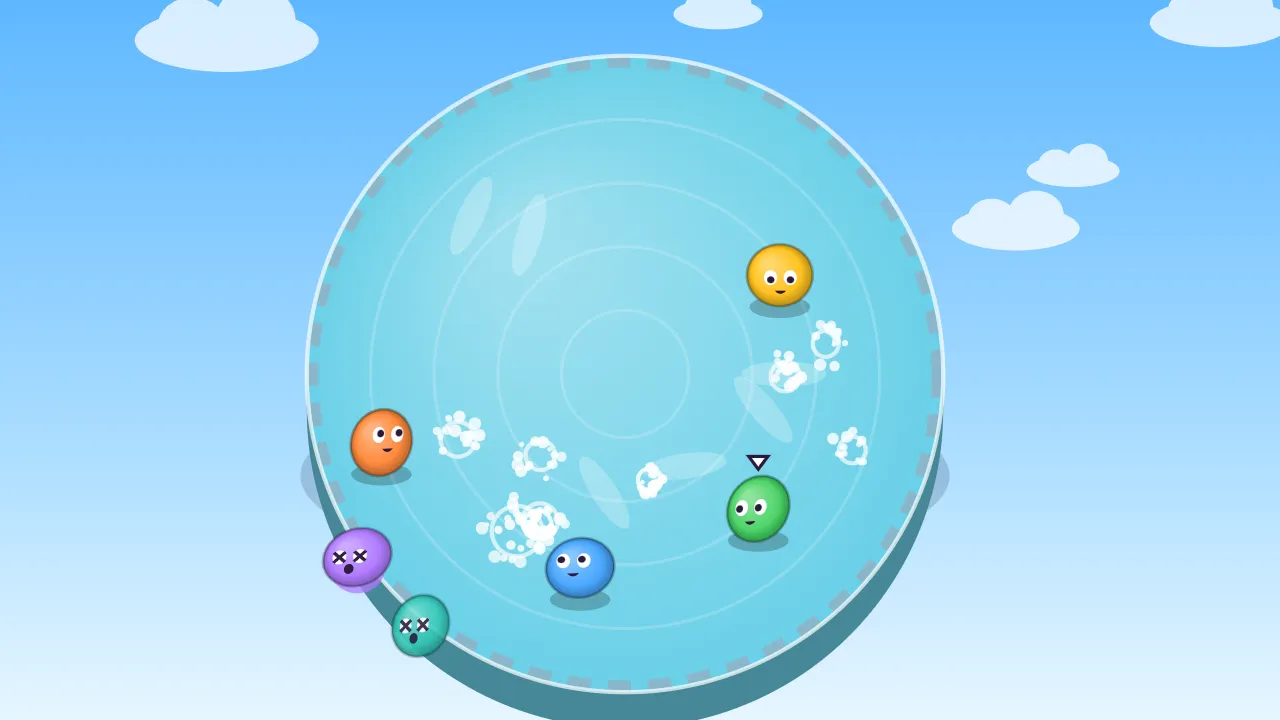
The safest spot is always near the middle of the platform. From there you have room to back off in any direction, while an opponent at the edge only needs a small nudge to fall. Since the platform starts shrinking about eight seconds into each round, the centre is also the only ground that never disappears.
At the start of a round all six players are in a ring near the edge. A good first move is to head for the centre at a moderate speed rather than charging at the nearest opponent. Whoever reaches the middle first gets to choose when to fight.
Dash technique
The dash is both the strongest and the riskiest tool in Arena Senggol. A well-timed dash can knock an opponent straight off, while a missed one can send you sliding off the platform yourself.
The recharge is about 1.3 seconds. That sounds short, but late in a crowded round, 1.3 seconds without a dash can decide who falls. So every dash needs a plan.
Dash just before impact
The hardest bump happens while you’re still moving at dash speed. Start your dash from close range, roughly two to three body widths away. A dash from far away gives the target time to dodge, and you’ve already slowed down when you arrive.
Push toward their nearest edge
Before dashing, line yourself up so the opponent sits between you and the edge. A hit toward the centre only moves them. A hit toward the edge can be an instant KO.
Don’t dash near the edge
If the opponent dodges, you’re the one who slides off. Near the edge, move normally and let them come to you.
Save a dash for defence
A dash can also save you. If you’re pushed toward the edge, dashing back toward the centre can cancel the push. Players who always spend their dash on attacks have no escape when they’re counter-attacked.
Reading opponents
Computer opponents have patterns you can learn. They go for nearby targets, dash when they think they have a chance, and on higher difficulties they’re more careful near the edge. Understanding those patterns lets you punish their mistakes.
The basic principle is to let opponents tire themselves out first. An opponent that has just collided has lost speed and its dash is recharging, which makes it the easiest target on the platform.
Let them fight each other
Early in a round, the computer players often go straight for each other. Waiting in the centre and watching is often better than joining the scramble.
Hit stunned opponents
A character that takes a hard hit is stunned for a moment. A second bump right then almost always ends in a fall. A KO also counts for you if you were the last to touch them within three seconds before they fall, so even a follow-up touch is worth points.
Don’t be the only target
On Hard, the computer targets you more often. If two opponents close in at once, move so they line up. The one in front shields you from the one behind.
Using power-ups
Power-ups appear every 6 to 10 seconds and can change the course of a round. The important question isn’t only which power-up is good, but when it’s worth grabbing.
As a rule of thumb, power-ups last about seven seconds. Taking Grow early in a round, while the platform is still wide, is far less useful than taking it when three players are left on a shrunken platform.
Grow and Heavy when the platform is small
Late in a round space is tight and every bump is dangerous. Grow makes you twice as heavy and Heavy makes you three times as heavy. Either one makes you almost impossible to push.
Shockwave when surrounded
Shockwave goes off the moment you grab it and throws every nearby opponent away. It’s strongest when three or four opponents are clustered near it.
Deny power-ups
A grown opponent late in a round is very hard to beat. Sometimes it’s worth taking a power-up just so they don’t get it.
Arena-by-arena strategy
Each arena needs a small adjustment. The principle of holding the centre still applies, but where the “safe centre” is and how you move can change.
On Classic Ring, play the fundamentals: hold the centre and attack opponents at the edge. On Donut, the centre is dangerous because of the hole, so move on the inner ring, close to the hole but not on its lip. On Frozen Lake, slow down and start braking early, because dashing on ice is very risky. On Pillar Park, stand near a pillar so opponents who hit you from that side bounce back. On Tiny Island there’s no time to wait, so take the centre as fast as you can.
Points strategy across a match
A match lasts five rounds, so the best strategy can change depending on where you stand. One KO is worth 2 points, and the gap between first and second place in a round is also 2 points.
If you’re behind, playing aggressively for KOs often helps more than passive survival. If you’re well ahead going into the last round, finishing top three is enough, so avoid unnecessary risks.
Conclusion
All of these tips boil down to three habits: hold the centre, dash with purpose, and take power-ups at the right time. Start on Easy to get a feel for momentum, then move up to Medium and Hard once you can win consistently.
Every match also earns coins toward new characters, from Yellow at 60 coins to Gold at 400. Play Arena Senggol now and put the strategy to work.
Continue practicing in Arena Senggol.