
How to Play Toko Cilik
Serving customers, 12 days in 3 shops, money and change, stars, coins, and decorations.
Toko Cilik (Little Shop) is a shop simulation game for kids. The player runs a shop for animal customers: reading shopping lists, taking items from the shelf, working out the total, and giving change in Indonesian rupiah. Without noticing, children practise recognising money values, addition, subtraction, and reading simple words.
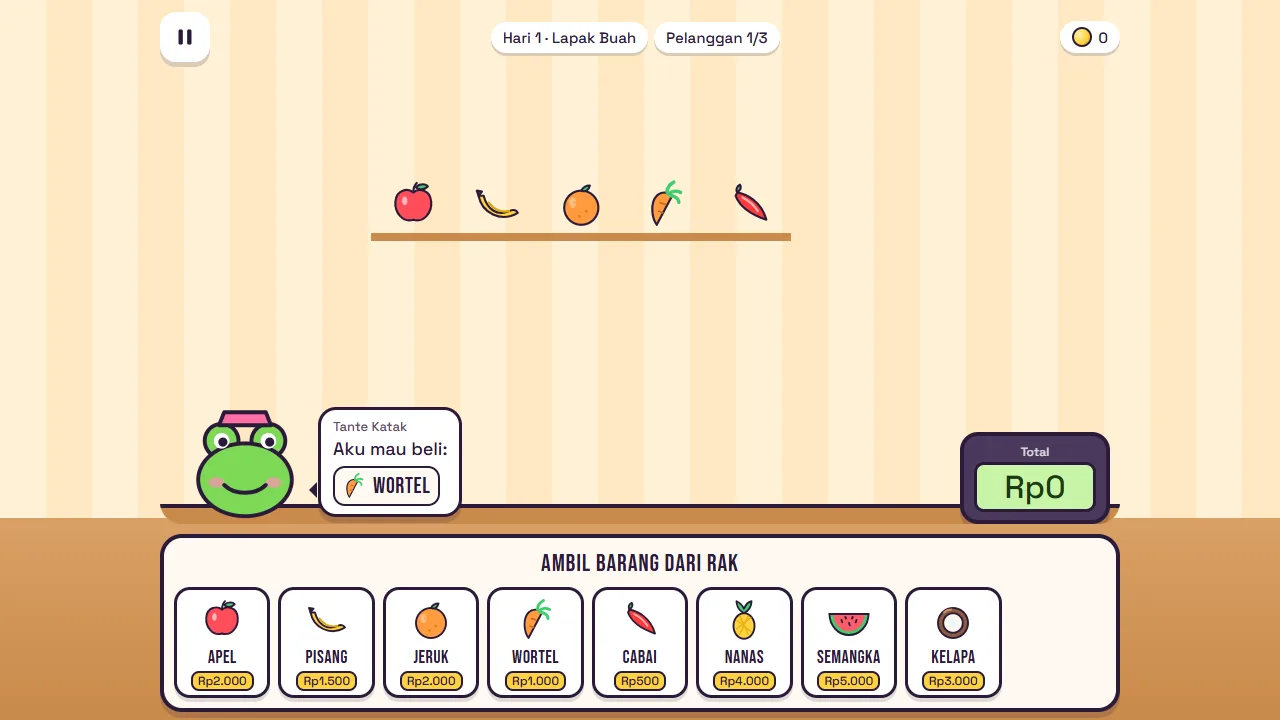
Serving a customer
- Read the shopping list. The customer lists what they want in a speech bubble. On early days the list has pictures and words; later it is words only.
- Take the items from the shelf. Tap the matching items. Each has a price tag.
- Work out the total. On early days the till adds it up. From day 4, the child picks the right total from three options.
- Take the payment. The customer pays with a banknote. If it is the exact amount, the sale is done.
- Give the change. Tap money in the till drawer to move it to the blue tray, then press Give. Tap money on the tray to put it back.
Twelve days, three shops
| Day | Shop | New challenge |
|---|---|---|
| 1 | Fruit Stall | One item, exact money, no change |
| 2–3 | Fruit Stall | Giving change; the change amount is shown |
| 4 | Fruit Stall | Two items, the child picks the total |
| 5–6 | Bakery & Drinks | Shopping lists in words only |
| 7–8 | Bakery & Drinks | Change must be worked out: money paid minus the total, and customers sometimes pay with big notes |
| 9–12 | Toy Shop | Higher prices and up to three items |
The next day opens once the previous one is finished. Any day can be replayed for 3 stars.
Money in Toko Cilik
The till holds Rp500 and Rp1,000 coins and Rp2,000, Rp5,000, Rp10,000, and Rp20,000 notes. Customers pay with notes up to Rp50,000. The money is deliberately drawn in a simple style with big numbers and distinct colours, not as copies of real banknotes. While playing, try matching them with real money at home.
Stars, coins, and decorations
- 3 stars for at most 1 mistake in a day, 2 stars for 2–4 mistakes, and 1 star otherwise. A day can always be finished.
- Mistakes count when taking an item that is not on the list, picking a wrong total, or giving the wrong change. If the change is short or too much, the game shows the difference.
- Each customer earns 10 coins plus a star bonus. Spend coins in Decorate on a striped awning, a flower pot, fairy lights, a shop cat, a shop sign, and balloons. Decorations appear in the shop right away.
Controls
- Touch / mouse: tap items, total options, and money.
- Keyboard: Enter presses Give, Esc or P pauses.
- Customer voices use the browser's built-in speech and can be turned off in Settings.
Progress, coins, and decorations save automatically in the device's browser. Tips for teaching children about money are in our guide to introducing rupiah.
Prices in every shop
| Shop | Items and prices |
|---|---|
| Fruit Stall (days 1–4) | chilli Rp500, carrot Rp1,000, banana Rp1,500, apple Rp2,000, orange Rp2,000, coconut Rp3,000, pineapple Rp4,000, watermelon Rp5,000 |
| Bakery & Drinks (days 5–8) | candle Rp1,500, coffee Rp2,500, bread Rp3,000, milk Rp4,000, plus apples, bananas, oranges, and watermelons |
| Toy Shop (days 9–12) | yo-yo Rp3,500, book Rp4,500, ball Rp5,000, hat Rp6,000, umbrella Rp8,000, shoes Rp10,000, plus bread and milk |
Prices come in steps of Rp500, so children get used to thousands and half-thousands, just like at a real Indonesian stall. Rp means rupiah, Indonesia's currency.
How customers pay
Customers pay with the smallest note that covers the total: Rp1,000, Rp2,000, Rp5,000, Rp10,000, Rp20,000, or Rp50,000. On day 1 the money is always exact. From day 2, customers pay more so there is change to give. From day 7, customers sometimes pay with an even bigger note, such as Rp20,000 for a Rp6,500 shop, so the change is larger.
Worked change examples
- Fruit Stall: apple Rp2,000 + banana Rp1,500 = Rp3,500. The customer pays Rp5,000. Change is Rp1,500: one Rp1,000 and one Rp500 coin.
- Bakery: bread Rp3,000 + coffee Rp2,500 = Rp5,500. The customer pays Rp10,000. Change is Rp4,500, for example Rp2,000 + Rp2,000 + Rp500.
- Toy Shop: hat Rp6,000 + ball Rp5,000 = Rp11,000. The customer pays Rp20,000. Change is Rp9,000, for example Rp5,000 + Rp2,000 + Rp2,000.
An easy method for children is counting up from the total to the money paid. For the last example: from 11,000 add 2,000 to reach 13,000, add 2,000 to reach 15,000, add 5,000 to reach 20,000. The money you added is the change.
Picking the right total
From day 4, the child picks the total from three options. Wrong options differ from the right total by Rp500 to Rp2,000. Encourage adding the thousands first, then the hundreds. Watch the hundreds too: if exactly one item ends in 500 (such as a banana at Rp1,500 or coffee at Rp2,500), the correct total must end in 500. With two such items, the total ends in 000 again.