
How to Play Susun Permata
Controls, scoring, combos, Classic mode, and Adventure level goals.
Susun Permata (Gem Stack) is a block puzzle played on an 8×8 board. You can learn the rules in a minute: drop a piece, fill a row or column, and that line clears for points. What keeps it interesting are the details underneath, like how the score is calculated, when a combo breaks, and why a board that looks roomy can suddenly jam.
This guide walks through all of it in order, from the controls and piece shapes to scoring and every Adventure level goal. If you’re brand new, read from the top. If you’ve already played a few rounds, feel free to jump to the scoring and Adventure sections.
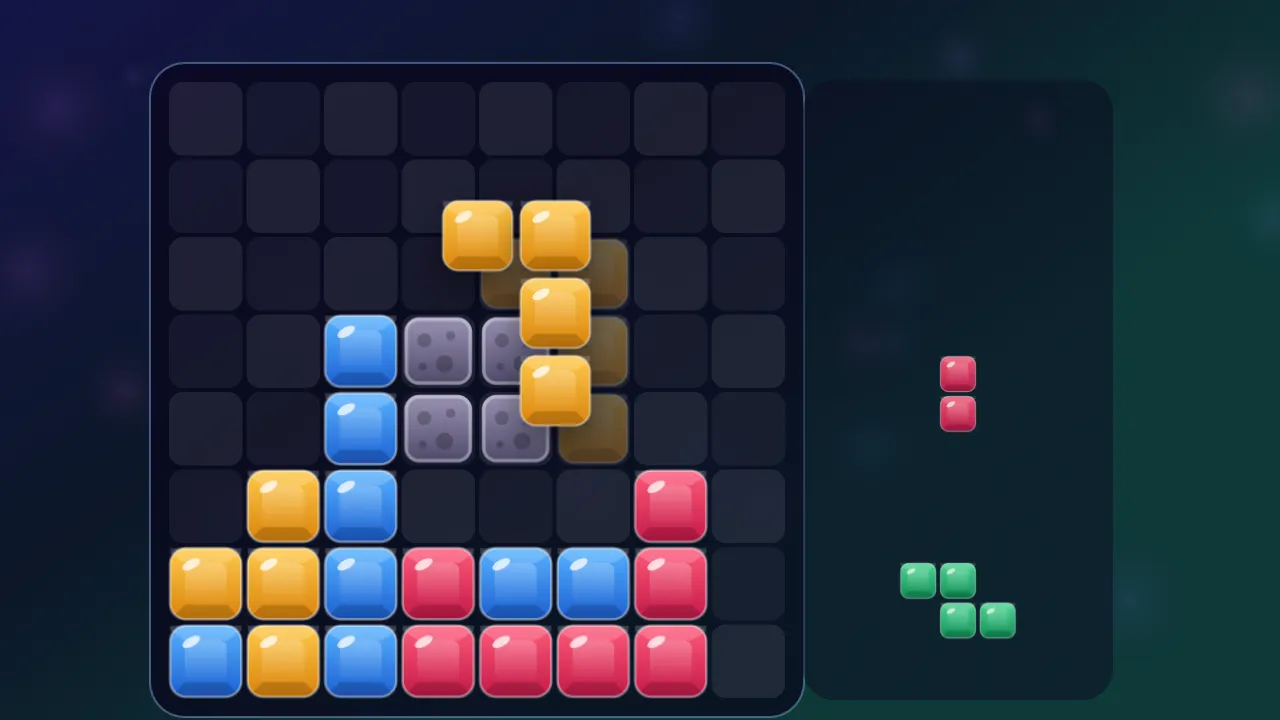
The goal
Below the board is a tray of three pieces. You can place them in any order, and the tray only refills once all three are used. Whenever a horizontal row or vertical column is completely filled, it clears and those cells become empty again. That’s the only way to make space on the board.
The game ends when none of the pieces in the tray fits anywhere. So you don’t lose because the board is full. You lose because the pieces you’re holding have nowhere to go. A board with 20 empty cells can still be game over if the gaps are scattered and the tray holds a 3×3 block.
One more thing to remember from the start: pieces can’t be rotated. An L facing right and an L facing left are two different pieces. When you judge empty space, think about the shapes actually in the tray, not shapes you hope to flip later.
Controls on phone, mouse, and keyboard
Susun Permata is built for touchscreens, but it plays just as comfortably with a mouse or keyboard. On a phone, the piece is drawn slightly above your fingertip so your hand doesn’t hide it while dragging. On a computer, you can use the mouse or pick a piece with the number keys and move it with the arrows.
Whatever you use, the board always shows a placement shadow and lights up any line that will clear while the piece is being moved. You see the result before you let go. If no shadow appears, the spot isn’t valid and the piece returns to the tray. The details are in the table below.
| Action | Touchscreen | Mouse | Keyboard |
|---|---|---|---|
| Pick a piece | Touch a piece in the tray | Click a piece | 1 2 3 |
| Move | Drag | Drag | Arrow keys |
| Place | Lift your finger | Release | Enter / Space |
| Cancel / pause | Pause button | Pause button | Esc / P |
Keep an eye on the tray, too. A piece that fits nowhere is shown dimmed. It’s the most honest warning the game gives: once two pieces are dimmed, you need to open space for the third or the run is about to end.
Piece shapes
There are dozens of piece variations, and every facing counts as its own piece. Small pieces like the single cell, the two-cell line, and the mini corner appear throughout the game. Medium pieces include the 2×2 square, the four-cell line, and the L, J, T, S, and Z shapes familiar from other block games.
The large pieces are the ones to watch: the five-cell line, the 2×3 rectangle, the big 3×3 corner, and the solid 3×3 block. All of them need open space that hasn’t been chopped up. On the other hand, the two-cell diagonal piece is often underrated. Its cells don’t share an edge, which makes it perfect for patching two holes that sit at an angle.
How scoring works
Points in Susun Permata come from two places. First, every cell you place is worth one point, so a 3×3 block adds nine points straight away. Second, and far more important, every line you clear scores, and the value climbs steeply when several lines clear together.
One line is worth 10 points. Two lines at once are worth 30, three lines 60, four lines 100, and five lines 150. That means three lines cleared together are worth twice as much as the same three lines cleared one at a time. On top of that there’s a combo multiplier and an empty-board bonus, explained below.
- Combo: goes up one level each time you clear lines on consecutive placements. Each level adds 0.5× to the multiplier, so at combo 2 a two-line clear is worth 30 × 2 = 60 points.
- Combo grace: one placement without a clear doesn’t break the combo. It only resets after two placements in a row without a clear.
- Empty board: clearing the whole board gives a 300-point bonus.
Classic mode
Classic is an endless mode for chasing a high score. There’s no move limit and no goal other than surviving as long as you can. It’s great for relaxed sessions and the best place to practise board management.
The difficulty rises gradually. Early on, small pieces show up more often. As you keep placing pieces, the odds of large and awkward shapes climb until they peak after about 240 placements. Small pieces still appear until the end, just less often. Your best Classic score saves automatically in your browser, so your record is still there next time on the same device.
Adventure mode: 60 levels in six lands
Adventure has 60 levels split across six lands of 10 levels each: Crystal Garden, Sapphire Cave, Topaz Desert, Amethyst Palace, Ruby Mountain, and Diamond Sky. Every level starts with a pre-filled board, a specific goal, and a move limit. One move is counted each time you place a piece.
Goals rotate between three types. Some levels ask you to collect gems, some to break every stone, and some simply to reach a target score. A few levels combine gems and stones, and those are usually the ones that eat the most moves.
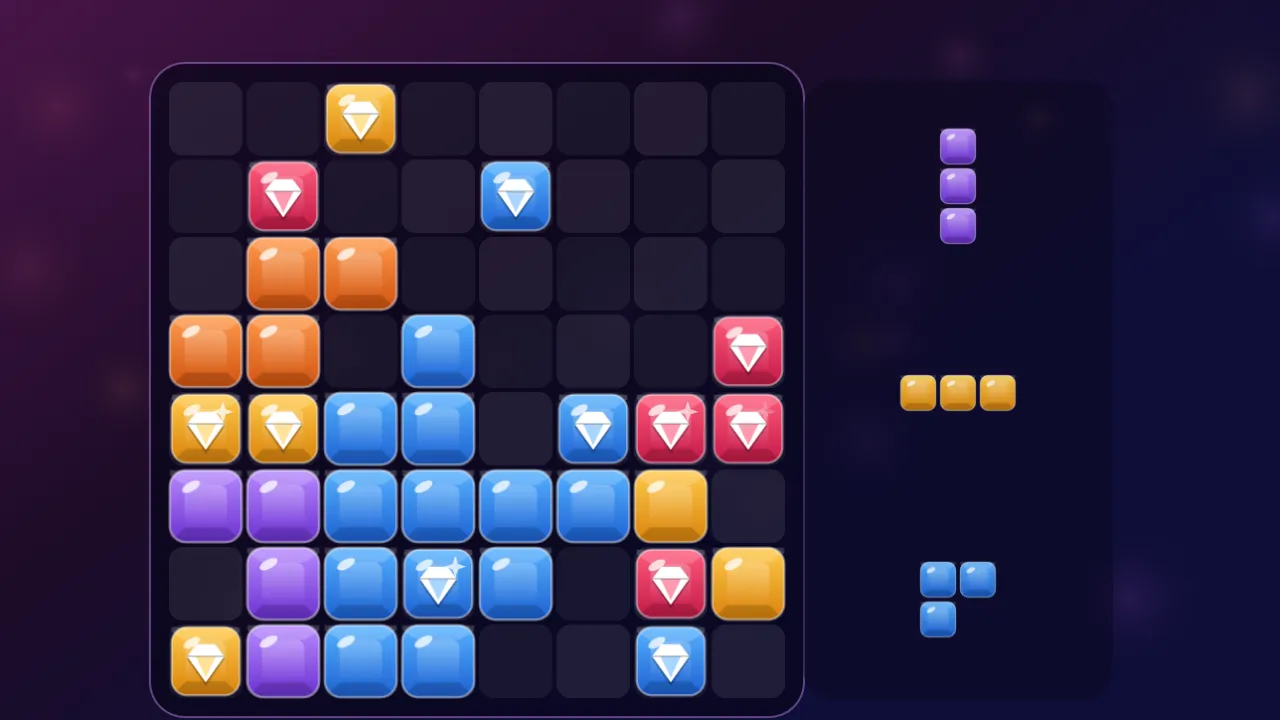
- Collect gems: gem blocks clear when their row or column is completed. The counter above the board shows how many of each colour are left.
- Break stones: grey stone blocks can’t be moved and only disappear when a line they sit in clears.
- Reach a score: hit the target before you run out of moves.
From the middle of Adventure onward you’ll meet iced blocks. Ice needs two clears: the first only cracks it, the second breaks the block. The number of piece colours also rises from four in the early levels to seven in the last ones. Colour doesn’t change the clearing rules, but a busier board is harder to read.
Stars and move bonus
Every move you have left when you win turns into 20 extra points. Those spare moves also decide your stars, so finishing a level efficiently pays off twice.
You get three stars with at least 35% of your moves left, two stars with at least 15%, and one star for any win with fewer. For example, on a level with a 40-move limit you need 14 moves left for three stars and 6 for two. Finished levels can be replayed at any time to improve your stars.
Common beginner mistakes
Almost every new player loses in a similar way. The board looks fine, then a 3×3 block arrives and there’s nowhere to put it. The cause is rarely one big move. It’s usually a few small habits adding up.
The first habit is dropping pieces in the middle of the board, even though the centre is the most valuable space for large pieces. The second is placing the first piece without looking at the other two, so the third one loses its spot. The third is leaving trapped one-cell holes that only a single-cell piece can fill. And finally, many players chase combos until the board is packed, when an overcrowded board ends faster than a broken combo costs them.
Frequently asked questions
These are the questions new Susun Permata players ask most often. The answers are short, but they can save you some time if you’re unsure about something.
If your question isn’t covered here, you can reach us through the Help page.
Can I play Susun Permata on my phone?
Yes. It runs in the browser on phones, tablets, and computers with nothing to download, in both portrait and landscape.
Is my Adventure progress saved?
Yes. Completed levels, stars, and best scores are kept in your browser’s local storage. Clearing site data in your browser will delete that progress too.
Can pieces be rotated?
No. Every facing is its own piece, so plan your empty space around the shapes in the tray.
What to do next
Once you understand the rules and scoring, the next step is learning to manage the board so your runs last longer. We cover that strategy in detail in the Susun Permata high-score tips, including an example of what to do when the board is nearly full.
If you’d rather dive in, play Susun Permata now. Start with a few rounds of Classic to get to know the pieces, then move on to Adventure once you feel comfortable.
Continue practicing in Susun Permata.